How can you quickly thaw the acute phase of frozen shoulder?
Sep 22, 2025
Leave a message

So why is "frozen shoulder" singled out?
As frozen shoulder worsens, the range of motion of the shoulder joint becomes increasingly limited. In severe cases, the shoulder joint may even become completely immobile. This is why frozen shoulder is described as "frozen." There's another reason, though. This begins with the stages of frozen shoulder development.
Three Stages of Frozen Shoulder
Clinically, frozen shoulder is generally divided into three stages: the frozen phase, the stiff phase, and the thawing phase.
1. The frozen phase
Also known as the acute phase or the gradual frozen phase, the primary pathological change in the shoulder soft tissue during this stage is excessive exudation of serous fluid. Patients often experience severe localized pain, a sharp decrease in active range of motion, and increased pain at night. This stage can last for 6 to 9 months.
2. The stiff phase
Also known as the frozen phase or the chronic adhesion phase, this phase is characterized by motor dysfunction, with both active and passive motion limited. While pain is less severe than before, stiffness and range of motion gradually increase. Moving the shoulder becomes more difficult, and completing daily activities becomes more challenging. This stage can last for 4 to 12 months.
3. The thawing phase
Also known as the thawing phase or the recovery phase, shoulder pain is significantly reduced, sometimes to soreness without pain. The active range of motion of the shoulder joint gradually increases, demonstrating a self-limited nature. This stage can last from 6 months to 2 years. When frozen shoulder is in its "frozen phase," the shoulder is essentially immobile, which is why it's also called "frozen shoulder."
Since frozen shoulder can resolve on its own, does that mean we can just ignore it?
No! Not only do we need to address it, but we need to address it during the acute phase, also known as the frozen phase!

The significance of treating frozen shoulder during its "frozen phase"
Those who haven't experienced frozen shoulder and its pain might think it can be cured without treatment when they hear the term "self-limiting."
However, only those with frozen shoulder understand the intense pain during its acute phase. Even moving the shoulder hurts, especially during sleep. Often, people can't sleep all night. The slightest movement of the arm or the slightest turn awakens them in pain, making it difficult to fall asleep again.
Frozen shoulder typically recovers spontaneously over a period of three to six months. Active treatment during the "frozen phase" can shorten recovery time and accelerate recovery.
How to manage frozen shoulder during the "frozen" phase
Recommended "thawing" methods
1. Wall Climbing Exercise
Facing a wall, slowly climb up the wall with both hands or one hand, raising your upper limb as high as possible, then slowly lower yourself back to the starting position. Repeat several times.
2. Hand Pull Behind Your Body
With both hands behind your back, grasp the affected wrist with your unaffected hand and gradually pull upward. Repeat.
3. External Rotation Exercise
Stand with your back against a wall, clench your fist, bend your elbow, and externally rotate your arm, trying to touch the back of your fist to the wall. Repeat several times.
4. Ear Touching Exercise
Stand or sit, raise your hands overhead, then bend your hands and try to touch your ears, keeping your head in a neutral position.
5. Massage
Professional techniques such as Tuina and Reflexology can alleviate pain symptoms, reduce muscle hypertonia, and relieve muscle tension.
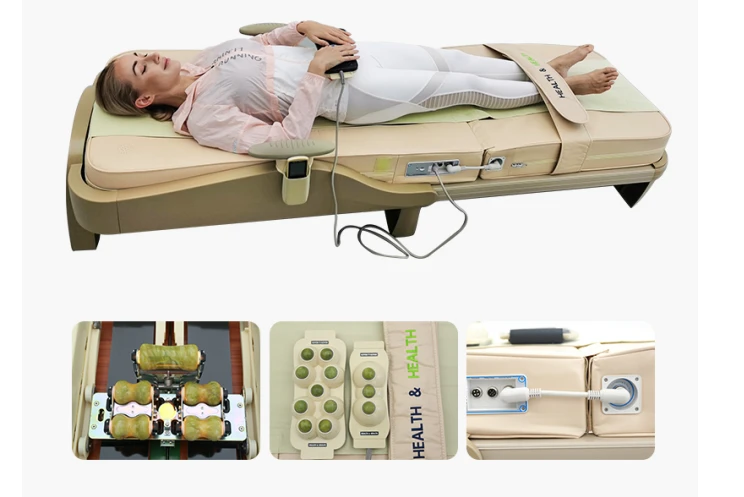
People-oriented, technology-driven warmth. Health&Health Thermal Therapy Device jade massage bed - carefully selected Chinese Xiuyan jade is deeply processed, and technology is used to create a comfortable and natural warm feeling. Every design is unique; every model is just for you.